

I’ve been heads-down since December, pivoting Wanderly toward social-emotional learning (SEL), so I forgot to pull my head up and give y’all an update. I’m seeing some positive signals given this new direction, but I’m still far from escape velocity. This post will be an action-packed summary of everything I’ve done and the positive signs I’m seeing.
Where I need help right now: If you have a connection to an elementary school or a preschool, I’d love a warm introduction. I’m looking to pilot Wanderly as a social-emotional curriculum with 5 schools in the fall. I’ll make it super easy: copy-paste the intro email at the bottom of this post and cc me (laura@wander.ly).
What was hard vs. what I thought would be hard
Before really getting into it all the work, I just want to say: I think it’s all been worth it. Last Friday, I got my first official endorsement from a credentialed professional. I’ve been working with Hilary off-and-on for almost 1.5 years. I wouldn’t have had the confidence to move in this direction if it hadn’t been for her advice over this time, and it feels great to have finally earned her trust:
“As a clinician, I wholeheartedly endorse this interactive storytelling app. It creatively integrates cognitive-behavioral strategies into engaging stories that empower children to recognize and reframe unhelpful thoughts. By guiding children to see that they have the ‘superpower’ to feel better, it not only fosters emotional resilience but also helps them feel less alone in navigating challenging emotions. This app is a thoughtful, imaginative, and evidence-informed tool supporting a child’s mental and emotional growth. It is a wonderful program that can be used in schools, homes, or therapy practices.” - Hilary Katz SSW, LICSW, LCSW-C
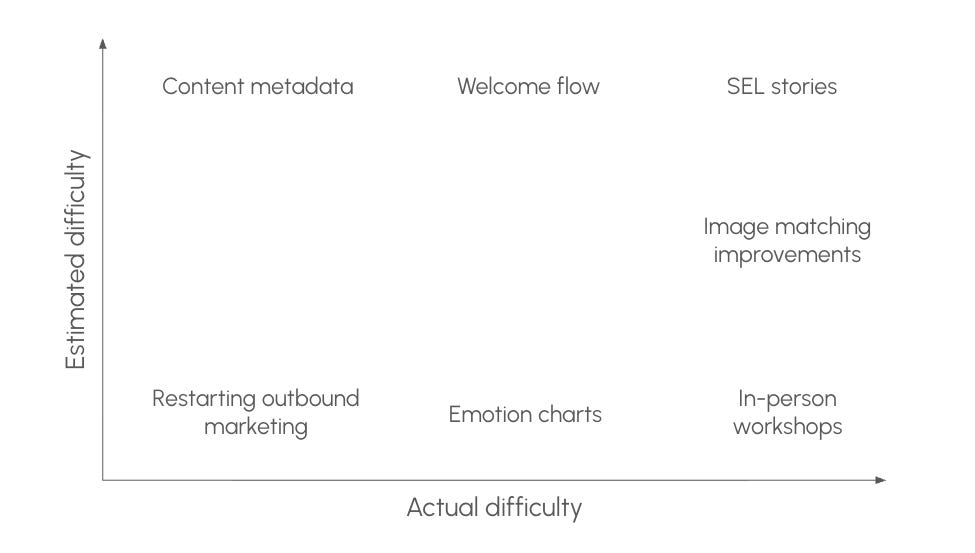
Now, back to the work. Here’s a quick visual of all the things I’ve been up to. Clearly my estimates need some work, but the distribution is pretty okay. 😆
Building Social-emotional Stories
Thought it would be hard, got a little lucky, but still hard
In December, I had about 30 stories in Wanderly, of which only a handful were specifically for social-emotional learning. In the new year, I started the arduous task of building a library of SEL stories, and wasn’t sure where to start. I conducted desk research and a parent survey to understand which kinds of stories they would find interesting. But then I got lucky: in response to my last newsletter, an old friend / former teacher introduced me to the CASEL standards, the standards work that is the foundation of most social-emotional curriculum in the US.
That gave me a blueprint for the kinds of stories that would make Wanderly useful as a social-emotional curriculum. I began working towards that in earnest. Over the course of Jan and February, I added 15+ additional stories. Wanderly now covers ~80% of the CASEL Kindergarten through 2nd-grade standards, and it’s added a lot of legitimacy to my conversations with educators.
So, all this to say this newsletter really does help me build Wanderly. Thank you to everyone who has ever reached out. 😀
Content metadata
Thought it would be hard, but it ended up being pretty easy
After growing the Wanderly library by 50%, I realized I’d reached the limit of my library’s organization strategy. I also needed to surface all this awesome new, standards-aligned content to my users!
The difficult part of this was figuring out how I wanted to tag and display content. But once I had a plan in place, I could leverage AI code tools to build the admin interface to tag each story, create a coverage dashboard, and generate SEO content for my marketing site.
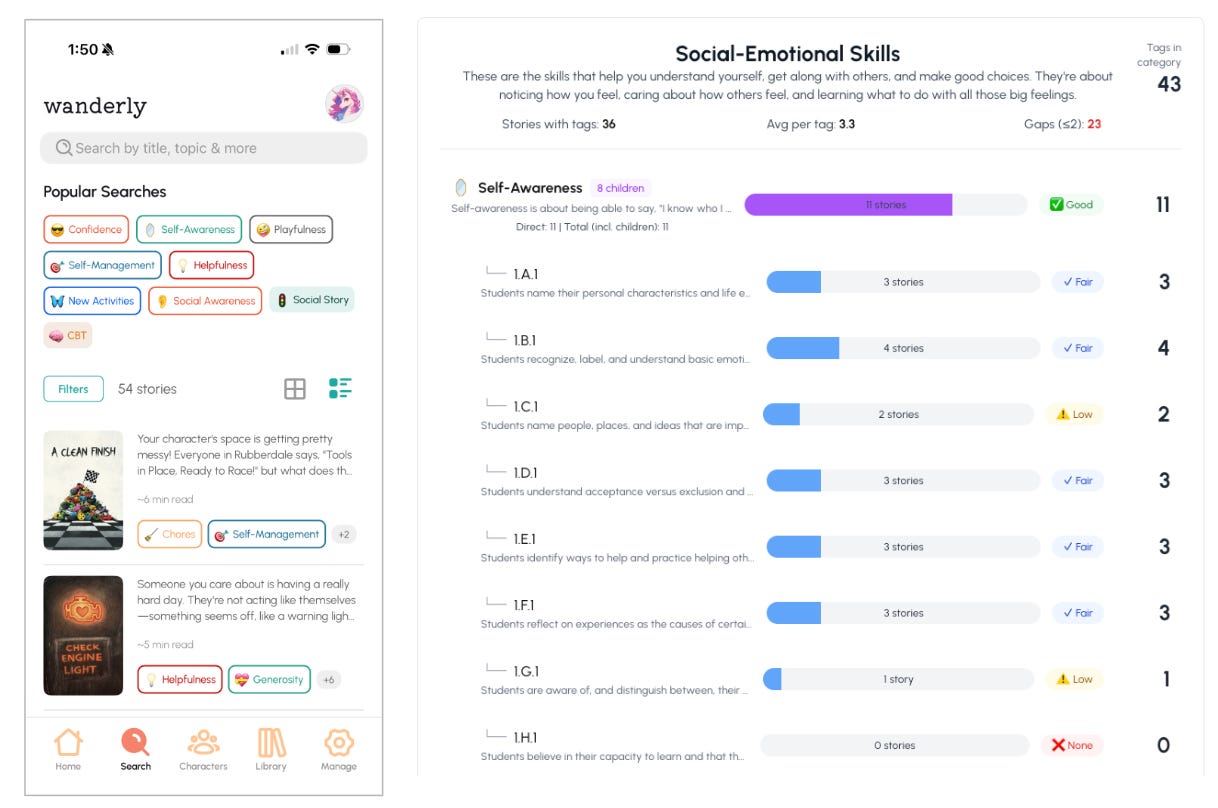
Image matching improvements
Thought it would be medium, ended up being very difficult
After spending a lot of time in content land, I also wanted to address the one piece of feedback my trusted testers gave me as a primary area of friction when recommending Wanderly: image-matching quality (I’ve been using embeddings to quickly match pre-cached images when a page is written). I took a quick detour to “treat myself”, and spent most of March and the early part of April going down an embedding rabbit hole.
I thought it was going to be easy, but it required several attempts before arriving at an insight that seemed obvious in retrospect: I thought I could follow advice that seemed aligned across Claude / GPT / Gemini on adding structured metadata to each image around “realm” (e.g., fantasy, school, space, sports, etc) to differentiate between things like a tree stick vs. a hockey stick, while keeping a preference to match on color, vibes, etc. Ultimately, the key insight was that I had to step back and consider the narrative purpose of the images. It was both a reality check and heartening to find a problem where my real brain could actually solve it better than an LLM.
I still think there are improvements to be made, but overall, image matching is in a much better place.
In-person workshops
Thought it would be easy, ended up being hard
When I moved away from social media in August, I decided to do more community-based marketing… but didn’t dive in immediately because I felt the product needed refinement. Once I’d aligned Wanderly stories with the CASEL standards, I felt like I finally had a framework to pitch to my local community: talk about Social-Emotional Learning + Wanderly.
I started by developing a proposal for local libraries and WIC (Women, Infant, Children) centers. In an ideal world, I’d offer a high-touch workshop that provided participants with quality educational resources while also giving me feedback about Wanderly. I made some PDFs1, and started to shop them around. I dropped off flyers and coupons at the SF Public Library, my local Oakland library branch, a local WIC center. People were always friendly with their time, but a crucial thing kept coming up: We can’t have you trying to sell something.
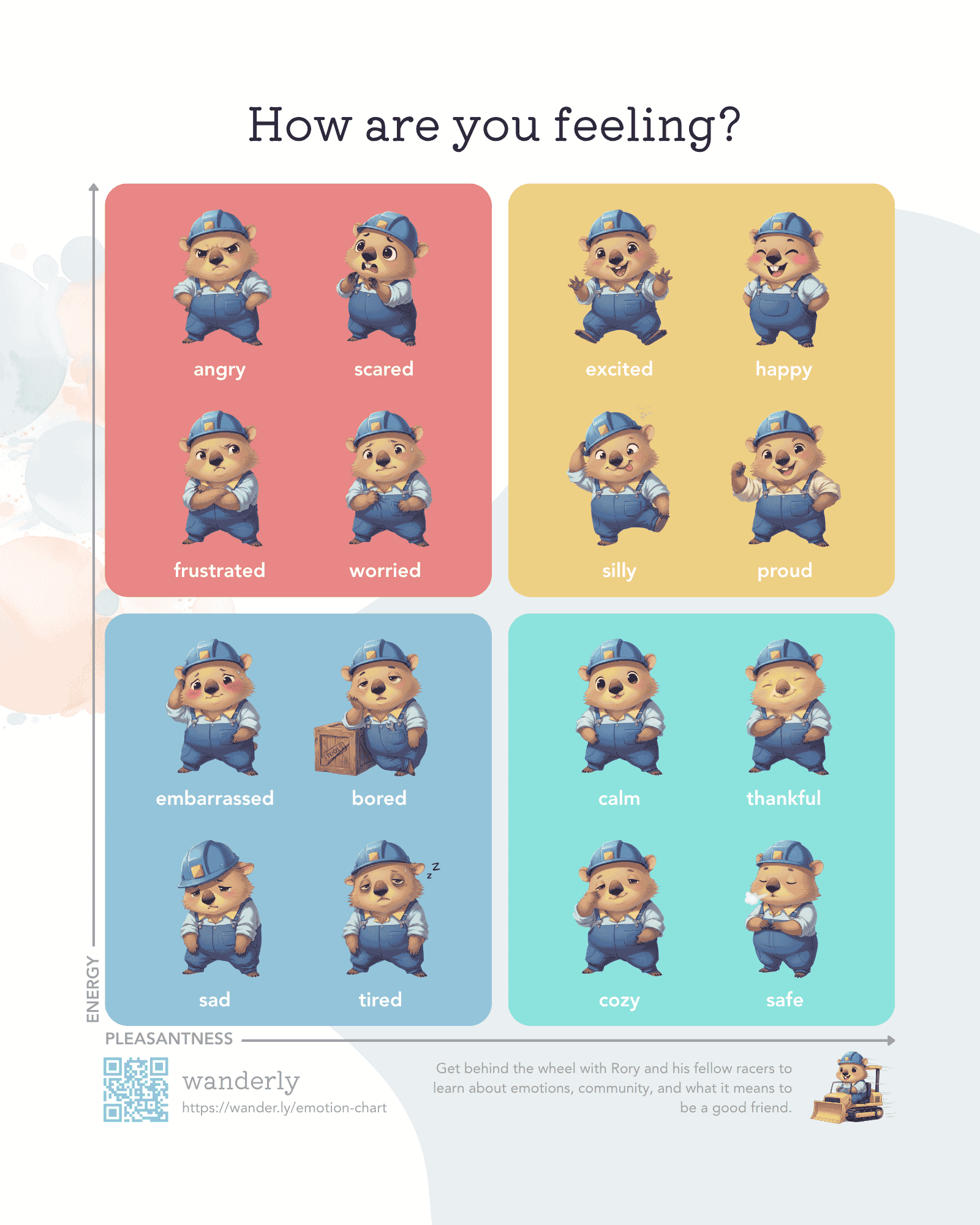
Ultimately, my daughter’s elementary school principal received my pitch, and we collaborated together to give a joint presentation to parents at the end of February. About 10-15 parents showed up, and were very engaged. Small scale, and I was very nervous, but I learned a lot: 1) one parent was captured by one of my characters on a slide, and then asked if I had an emotion chart with my characters (I didn’t, but I immediately made some) and 2) after the presentation, I asked one of the parents for feedback. She said, “It was great, I just wish you’d spent more time talking about your product; it seems great.” I responded with, “I just didn’t want to come across as too salesy.” “Don’t worry about that; you don’t come across that way.” Feedback noted.
Emotion charts
Thought it’d be easy, ended up being medium
I made my first emotion chart in response to my workshop request within 2 days; creating expressions for characters has gotten a lot easier with Nano Banana. But even so, it’s been hard to get right across all the characters; some are harder than others. Getting the right level of emotion from each character has also been a tight filter. That said, they’ve been very fun to make, and it’s cute that both my girls have asked for versions in their rooms. And who knows, they might even sell. 🤷♀️
Restarting outbound marketing
Thought it would be hard, ended up being easy
Okay, I know I said I was done with social media, but then a friend reached out and asked if they could use my Instagram and TikTok accounts to learn about AI marketing tools. I figured, why not?
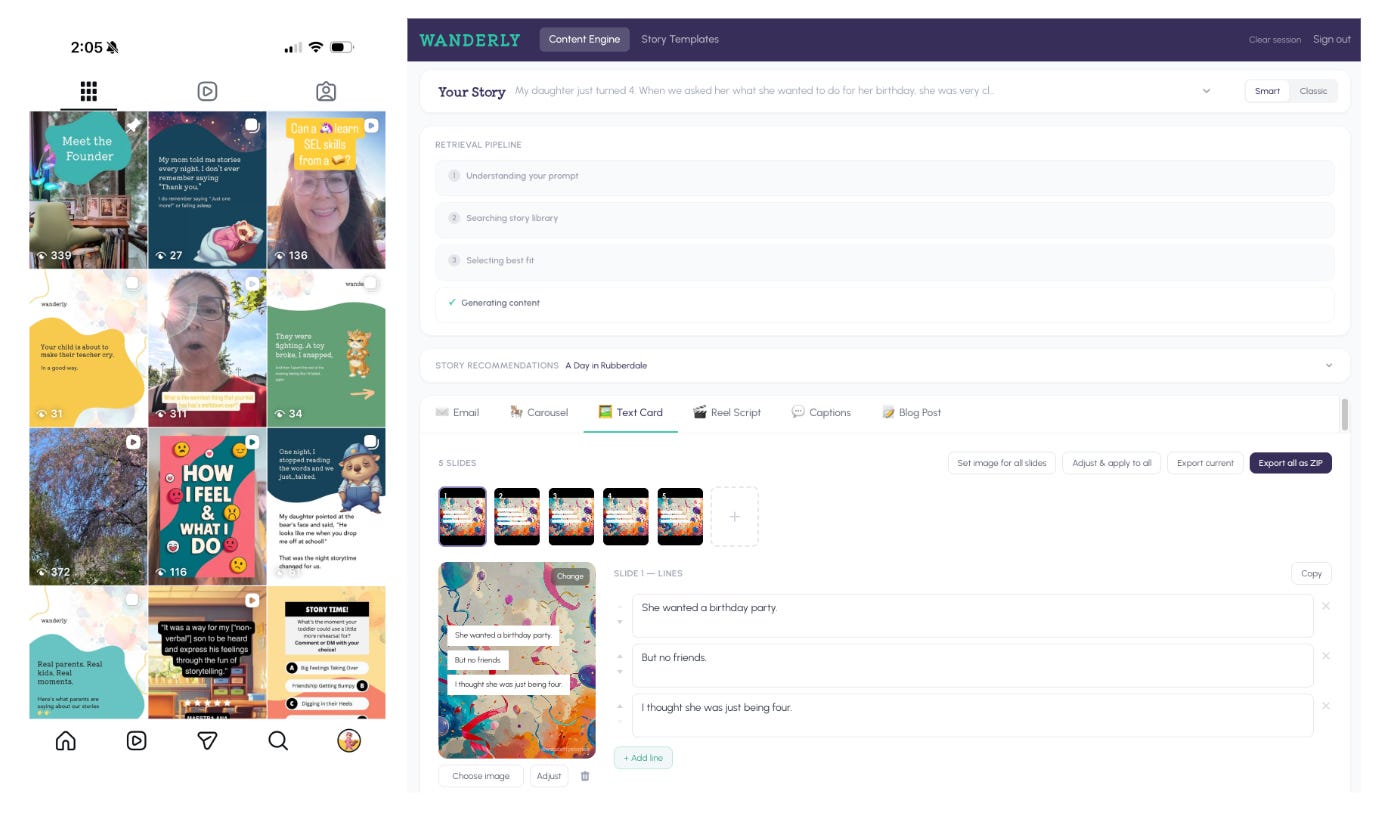
Turns out, when I change my relationship with social media from “I’m doing it for the likes” to “I’m doing this for a friend”, my whole outlook changed. With my friend’s help, we’ve been posting on social media about 5 times a week for the last month. We’ve learned a lot, gained a few followers, and I’ve built some AI-powered tools to help automate content generation (for social media content and for restarting outbound newsletter posts to my Wanderly marketing list).
Welcome flow
Thought it would be hard, ended up being medium (so far)
Over the last few weeks, I’ve been focusing on Wanderly’s welcome experience. It’s kind of the last major improvement I want to make before trying to ramp up outbound marketing, since I think my funnel is very leaky; i.e., if I get a user to walk through the door, they aren’t going to make it very far, and they probably won’t come back again. I just don’t really give them a reason to; I’ve been so focused on refining the core concept, I didn’t want to invest in the upfunnel until I knew what I wanted to build.
This is another place where I’ve tried to ask LLMs for help, but their advice hasn’t been valuable. For instance, I can get LLMs to suggest a flow to get a user to sign up for a paid trial… but I’m not sure that’s the right answer for me. If Wanderly was a productivity app, sure, but for a social-emotional learning tool for families with a premium price point without an established brand, I have to build trust. So… I have to use my real brain instead of outsourcing to AI. 🙂
But AI did help in other ways: With Claude Design and Claude Code, I created 3 interactive prototypes to test hypotheses for onboarding approaches, which I then tested with real parents using Prolific. I got my answers quickly. Now I need to actually build it.
I’m getting positive signals
Conversations have been different since I started building towards social-emotional learning. People are more willing to meet, my pitch is crisper, and I feel like doors are opening. It’s still slow, but I feel momentum gaining. I’m in conversations about running pilot programs for Wanderly as a social-emotional curriculum at elementary schools in the fall. I have a few more premium subscribers. I’m waiting on several things right now, which I hope to share soon. I’m optimistic.
So here’s to onwards and upwards. And if you can help me out by forwarding the message below to a school you’re connected to, I’d really appreciate it!
Cc: laura@wander.ly
Hi _____ -
I’m reaching out because a friend of mine has built a social-emotional learning tool called Wanderly, and I’m wondering if you’d be interested in learning more. It’s standards-aligned and uses interactive stories to help kids practice social-emotional skills between the ages of 3 and 8.
It requires very little teacher training and aims to bridge the gap between learning social-emotional skills at school and at home. It’s launching a free pilot for 5 schools in the fall. Would you be interested?
I’ve cc’ed the founder, Laura, on this email, and I’ll let you two connect.
All the best,
______
I can’t emphasize enough how each time I try to come up with marketing materials for Wanderly, it really helps me crystallize the value proposition. Nick Baum's (Storyworth CEO) advice lives rent-free in my mind: Spend at least 50% of your time on marketing.